
The Real Cause of Heart Disease, Diabetes, and Half of Modern Chronic Illness — And Your Doctor Probably Isn’t Even Testing for It
Here is one of the most under-publicized facts in modern medicine.
The single biggest cause of heart attacks today is not high cholesterol. It is not saturated fat. It is not even smoking.
It is insulin resistance — and standard cardiology screening doesn’t even measure it.
This is not a fringe contrarian claim. It is what comes out of the mathematical modeling when researchers run actual population data through actual disease simulations. It’s what shows up consistently in prospective cohorts, meta-analyses, and clinical studies of heart attack patients. It is the silent driver underneath nearly every chronic disease afflicting the developed world.
And almost nobody is talking about it.
This post is going to be longer than my usual. It needs to be — because once you understand insulin resistance, you understand why heart disease is happening to 30-year-olds, why type 2 diabetes prevalence has 5x’d in 30 years, why fatty liver disease is now the most common chronic liver condition on Earth, why PCOS is everywhere, why Alzheimer’s researchers are starting to call it “type 3 diabetes,” and why none of the standard medical advice is fixing any of it.
This is the foundation. Read this once and the rest of the chronic disease conversation makes sense for the rest of your life.
What Insulin Resistance Actually Is
Insulin is a hormone your pancreas makes whenever you eat. Its job is to take the glucose in your bloodstream and tell your cells — especially muscle cells, fat cells, and liver cells — to take it in and use it or store it. Insulin is the key. Your cells have insulin receptors. Glucose gets to come in.
In a healthy body, this works elegantly. You eat food, blood sugar rises, insulin spikes briefly, glucose gets put away into cells, blood sugar comes back down to normal. Insulin then drops back to baseline until you eat again. The whole system is supposed to be quiet most of the time.
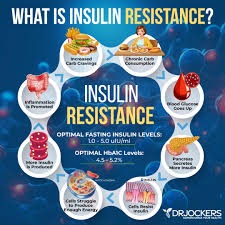
In a body with insulin resistance, the cells stop responding properly to insulin’s signal. The key still works — but the lock has gotten gummed up. Glucose has trouble getting into cells. Blood sugar runs higher than it should. The pancreas, sensing the higher blood sugar, panics and makes more insulin to try to force the glucose into cells. Eventually it works — sort of — but at the cost of chronically elevated insulin levels in your bloodstream, all day, every day.
That state — chronic high insulin — is called hyperinsulinemia, and it is the upstream catastrophe almost no one is measuring.
The cells, faced with constantly elevated insulin levels, start ignoring the signal even more. They downregulate their insulin receptors. They become more resistant. The pancreas pumps out more insulin. The cycle accelerates.
You can sit in this state — chronically elevated insulin, increasingly broken signaling — for ten, fifteen, even twenty years before your fasting glucose ever rises into the diabetic range. Your annual physical, which only checks fasting glucose, comes back normal every single year. You get told everything looks great. Meanwhile your liver is filling with fat, your blood vessels are inflaming, your hormones are scrambling, and your future heart attack is being assembled silently underneath a perfect lab report.
This is not rare. Roughly 40% of US adults aged 18 to 44 are insulin resistant by HOMA-IR criteria. The age-standardized prevalence of hyperinsulinemia in nondiabetic US adults rose from 28.2% in 1999-2000 to 41.4% by 2017-2018. And by the most rigorous metabolic health criteria, only about 12% of American adults qualify as metabolically healthy. The other 88% have some degree of dysfunction — most of which is insulin resistance, in some stage of progression.
Let that number sink in. Almost 9 out of 10 American adults are not metabolically healthy. Most of them have no idea.
Why It’s the Number One Cause of Heart Disease
Now to the headline claim, because this is where the data gets remarkable.
The Archimedes mathematical model — using real NHANES population data and running 60-year simulated clinical trials — concluded that insulin resistance is the most important single cause of coronary artery disease in the United States. According to that modeling, the risk of coronary artery disease is nearly three times greater in people who develop insulin resistance than in those who don’t.
The next biggest preventable cause? Hypertension. Preventing it would reduce heart attacks by roughly 36%. That is a distant second.
Cholesterol — the thing your doctor has been worried about for forty years, the reason 30+ million Americans take statins — does not even crack the top of the modeled list as a primary cause.
This is not a single fringe paper. The independent confirming evidence is enormous:
- Multiple prospective cohort studies have found that insulin resistance independently predicts cardiovascular events even after adjusting for every other classical risk factor — meaning it adds risk on top of what your cholesterol, blood pressure, and smoking already predict.
- Insulin resistance estimated by glucose tolerance testing predicts future cardiovascular events better than fasting glucose in nondiabetic individuals. Translation: the standard test most doctors run will miss the most predictive metabolic information about your heart.
- A 2014 study of 1,073 nondiabetic patients who had survived a heart attack found that the extent of their underlying coronary artery disease was independently predicted by their HOMA-IR score. These were patients with no diabetes diagnosis, who had just had a heart attack — and their underlying driver was insulin resistance no one had been measuring.
- The Nurses’ Health Study found that women who would eventually develop diabetes already had a 3.8-fold elevated heart attack risk before their diabetes was diagnosed. The cardiovascular damage is being done during the years of insulin resistance, long before diabetes shows up on a lab report.
- Metabolic syndrome — the clinical expression of insulin resistance — increases heart attack and stroke risk by 2 to 4-fold, even in the absence of full diabetes.
So when I say insulin resistance is the number one cause of heart disease, I am not editorializing. I am telling you what comes out of the actual mathematical modeling, the prospective cohorts, and the patient-level data when researchers look at heart disease honestly.
The cardiovascular conversation in mainstream medicine has been dominated for forty years by LDL cholesterol and statins. Meanwhile, the data on insulin resistance has been quietly piling up in the background, and almost no one outside the metabolic health community is hearing it.
Why It Drives Type 2 Diabetes (and Why Your “Normal” Glucose Is Lying to You)
Type 2 diabetes is, mechanistically, the late stage of insulin resistance. It is what happens when your pancreas finally cannot keep up with the demand to produce more and more insulin to overcome the resistance, and your blood glucose finally rises to the level where you get a diagnosis.
Here is the part that is genuinely scary if you understand it: by the time you are diagnosed with type 2 diabetes, you have usually been insulin resistant for 10 to 20 years.
Your fasting glucose stayed normal that whole time because your pancreas was working overtime to keep it there. You felt mostly fine. Your annual physical kept coming back normal. The damage to your blood vessels, your liver, your kidneys, your nerves, your brain — was quietly happening the entire time, beneath a perfect-looking lab report.
This is why the Nurses’ Health Study finding is so important. The cardiovascular damage in those women showed up before the diabetes did, because the damage doesn’t come from high blood sugar — it comes from chronically elevated insulin and the metabolic dysfunction it drives. By the time blood sugar gets high enough to call it diabetes, the train has been moving for two decades.
This is also why “fasting glucose is normal, you’re fine” is one of the most dangerous reassurances in modern medicine. Fasting glucose is the last thing to break in the insulin resistance cascade. By the time it’s elevated, you are years into structural metabolic damage.
Why Your Doctor Isn’t Catching This
Here is the part that turns understanding into action: standard cardiovascular and metabolic screening does not include the tests that would detect insulin resistance.
The typical “comprehensive” annual physical includes:
- A lipid panel (cholesterol, LDL, HDL, triglycerides)
- A fasting glucose
- An HbA1c (a 3-month average glucose marker)
- Blood pressure
- Sometimes hsCRP for inflammation
It almost never includes:
- Fasting insulin
- HOMA-IR (calculated from fasting glucose and fasting insulin)
- Triglyceride-to-HDL ratio (a useful proxy for insulin resistance)
- TyG index (another proxy)
- Continuous glucose monitor data showing real-world glucose response
The tests that would catch the problem 10 to 20 years before it shows up in the standard panel are not part of the standard panel.
Why? A combination of several reasons. Insurance coverage for fasting insulin testing has historically been spotty. Most cardiologists were trained in the cholesterol-as-cause model and haven’t updated. There is no pharmaceutical product that specifically targets insulin resistance the way statins target LDL — so the entire industry incentive structure pushes attention toward what can be drugged. And the metabolic health field, which has been making this case for years, is still considered a “specialty” rather than mainstream practice.
The result is that most Americans are walking around with no idea where they are on the insulin resistance spectrum. They’re getting “normal” lab reports for years while their metabolic foundation is quietly being demolished. They find out something is wrong the day they have a heart attack, get a fatty liver diagnosis, develop full-blown diabetes, or get told they have PCOS or metabolic syndrome — by which point, the dysfunction has been building silently for over a decade.
This is the missed-diagnosis crisis hiding inside every “everything looks great” annual physical happening across the country today.
Why It’s Behind Almost Every Chronic Disease
Once you understand the mechanism, you start seeing insulin resistance everywhere — because it is, in fact, the upstream driver of an enormous portion of modern chronic disease.
Cardiovascular disease — covered above. The single biggest preventable cause.
Type 2 diabetes — by definition, late-stage insulin resistance. 100% of T2D is downstream of this process.
Non-alcoholic fatty liver disease (NAFLD) — affects 25 to 38% of US adults. The liver is one of the primary sites of insulin resistance, and chronic hyperinsulinemia drives hepatic fat accumulation directly.
PCOS — the most common cause of female infertility. The vast majority of PCOS cases are insulin-resistance-driven. Treating the insulin resistance often resolves the PCOS symptoms.
Alzheimer’s disease — increasingly being called “type 3 diabetes” in the research community because brain insulin resistance appears to be a major driver of cognitive decline. The brain has insulin receptors. They can become resistant. When they do, neurons stop functioning properly.
Hypertension — chronic hyperinsulinemia activates the sympathetic nervous system and the renin-angiotensin-aldosterone pathway, drives sodium retention, and impairs vasodilation. All of these directly raise blood pressure.
Dyslipidemia — the high triglyceride / low HDL / small-dense-LDL pattern that drives atherosclerosis is the signature lipid pattern of insulin resistance.
Several cancers — particularly breast, colon, and pancreatic. Insulin and IGF-1 pathways drive cell proliferation. Chronic hyperinsulinemia provides exactly the growth signal cancer cells need.
Cognitive symptoms in everyday life — the brain fog, the energy crashes, the mood instability that millions of people accept as “just getting older” or “just stress” are often direct consequences of insulin resistance affecting brain function.
Acne, accelerated aging, hormonal dysfunction, sleep disruption, joint pain without mechanical cause — all have direct or indirect ties to insulin resistance and its downstream effects.
When I say insulin resistance is the central mechanism underneath modern chronic disease, this is what I mean. It is not one risk factor among many. It is the shared root that most of these conditions trace back to. The reason heart disease, diabetes, fatty liver, PCOS, Alzheimer’s, hypertension, and a long list of others have all been rising in lockstep is because they are all expressions of the same underlying broken process — and the food environment, the muscle deficit, the sleep deficit, and the stress load that drive that broken process have all been getting worse for decades.
What Actually Causes It
If insulin resistance is the central mechanism, what causes it?
The list is short and almost entirely modifiable:
Chronic excess of refined carbohydrates and added sugar. Every time you eat sugar or refined grains, insulin spikes. Do that constantly, year after year, and you train your cells to ignore the signal. This is the single biggest dietary driver, and it’s why we’ll be diving deep into sugar specifically in the next series.
Industrial seed oils and ultra-processed food. Linoleic acid from seed oils gets incorporated into cell membranes, including the membranes where insulin signaling happens. Ultra-processed food drives insulin resistance through multiple mechanisms beyond just sugar — emulsifiers, preservatives, additives, and the simple absence of nutrients real food provides.
Sedentary lifestyle and inadequate muscle mass. Skeletal muscle is the primary site of insulin-mediated glucose disposal. The more muscle you have, and the more you use it, the more insulin-sensitive you are. Sedentary modern life — jobs that don’t move, transportation that doesn’t move, recreation that doesn’t move — has produced a population with chronically inadequate muscle to handle the carbohydrate load it eats.
Chronic poor sleep. Even one bad night of sleep measurably impairs insulin sensitivity. Years of chronic sleep deprivation are a metabolic disaster.
Chronic stress and elevated cortisol. Cortisol directly raises blood glucose and antagonizes insulin’s actions. Chronic stress, in metabolic terms, is chronic insulin resistance.
Visceral fat accumulation. Fat around your organs is metabolically active and inflammatory in a way subcutaneous fat is not. It actively drives insulin resistance.
Environmental toxins, certain medications, and genetic predisposition. All play roles, though smaller than the big lifestyle drivers above.
Notice what’s not on this list: dietary saturated fat. Dietary cholesterol. Red meat. Eggs. Butter. The things mainstream nutrition has spent forty years telling people to fear are not significant drivers of insulin resistance. The things mainstream nutrition has been quietly recommending — low-fat, grain-heavy, vegetable-oil-based eating — are.
This is why the standard prevention advice has not worked. It was aimed at the wrong target.
What Actually Reverses It
Here is the genuinely good news, and it’s the reason this matters: insulin resistance, in most people, is reversible. Not slowed. Not managed. Reversed.
Studies have repeatedly shown that with sustained, comprehensive intervention, fasting insulin can normalize, HOMA-IR can drop into healthy range, fatty liver can resolve, and insulin sensitivity can be substantially or fully restored within months to a couple of years. The body has remarkable capacity to heal once you stop assaulting it and start supporting it.
The framework, in order of impact:
1. Eliminate added sugar and refined carbohydrates. Not “reduce.” Eliminate. This is the single biggest lever. Liquid sugar — soda, juice, sweetened drinks — is the worst offender and should be eliminated entirely, immediately, without exception. We will dive deep on this in the next blog series.
2. Eliminate seed oils and ultra-processed food. Replace with stable fats: butter, ghee, tallow, coconut oil, unrefined avocado oil, extra virgin olive oil. Replace ultra-processed food with actual food: meat, eggs, fish, vegetables, fruit, dairy if tolerated, properly prepared whole grains and legumes if tolerated.
3. Build muscle. Lift heavy weights. Skeletal muscle is your largest insulin-sensitive tissue and one of the most powerful insulin sensitizers available to you. The more lean mass you carry, and the more you train it, the better your metabolism handles food. This is non-negotiable. Cardio is fine but it does not replace lifting for this purpose.
4. Move daily. Not for calorie burn — for insulin sensitization. Walking after meals lowers postprandial glucose and improves insulin response. Daily movement matters more than occasional intense workouts.
5. Sleep 7 to 9 hours, consistently. This is not optional. Sleep deprivation is metabolic sabotage.
6. Manage stress. Chronic cortisol elevation undoes everything else you’re doing. This is why people who eat clean and lift hard but live in chronic stress often plateau.
7. Measure what matters. Stop relying on fasting glucose alone. Get fasting insulin, calculate HOMA-IR, look at your triglyceride-to-HDL ratio, and if available, use a continuous glucose monitor to see how your body actually responds to food in real life. These are the metrics that tell you whether your strategy is working.
8. Be patient. Insulin resistance was built over years and decades. Reversing it takes months and years. The lab values move first, the body composition follows, and the disease prevention is the long-tail payoff. You are not going to fix 20 years of dysfunction in 6 weeks. You can absolutely fix it in 12 to 24 months of consistent work.
The Bottom Line
If you take only one thing from this entire post, take this:
The number one cause of heart disease is insulin resistance. It drives type 2 diabetes, fatty liver disease, PCOS, Alzheimer’s, hypertension, and a long list of other modern chronic diseases. It affects roughly 40% of young American adults and almost 90% of all American adults to some degree. And your standard physical isn’t testing for it.
This single piece of information rearranges everything you have probably been told about chronic disease. It explains why heart disease is appearing in 30-year-olds. It explains why type 2 diabetes prevalence has exploded. It explains why “eat less fat, take a statin” hasn’t fixed the cardiovascular problem despite 40 years of trying. And it explains why a relatively simple intervention — the one we’ll keep talking about across this entire body of work — actually does work, when you do it for long enough and seriously enough.
The intervention is not complicated. Eliminate the food that broke you. Build the muscle you should have built decades ago. Sleep. Manage stress. Measure the right things. Give it time.
The complicated part is whether you’re willing to do it in a culture that profits from you not doing it.
What’s Coming Next
In the next series, we’re going deep on sugar specifically — the biggest single dietary driver of insulin resistance, and the one almost everyone is still underestimating despite decades of research. Three posts: the mechanism, the lag, and what to actually do about it. Including the part most “cut sugar” content gets wrong — the difference between fruit and added sugar, and the specific health conditions where even fruit needs to be temporarily paused.
Insulin resistance is the framework. Sugar is one of the biggest substances driving it. Heart disease, diabetes, fatty liver, and the rest are downstream.
Once you see the chain, you can’t unsee it. And once you can’t unsee it, you can finally start fixing it.
Welcome to the conversation almost no one in mainstream medicine is having.

